Anti-Dynasty #30: 2002-06 Houston Texans
Pack a sack lunch.

Peak Anti-Dynasty Points: 32
Record: 24-56 (.300)
Average DVOA: -23.8%
Bottom-Five DVOA: -23.8%
One last-place finish in the NFL; Four last-place finishes in the AFC South
Head Coaches: Dom Capers, Gary Kubiak
Key Players: QB David Carr, RB Domanick Williams, WR Andre Johnson, T Chester Pitts, C Steve McKinney, CB Marcus Coleman
Z-Score: -0.53
On the one hand, you want to cut expansion teams some slack. By these metrics, the Texans are just the fifth worst of the 12 modern-era expansion teams. They barely scrape together the 30 Anti-Dynasty points needed to qualify for the list in the first place. They had the misfortune to come into a division that would boast two legitimate Super Bowl contenders, Indianapolis and Tennessee. Surely, they deserve a pass for some of their poor play, yes? Well, I'd give them the opportunity for a pass, but they'd just allow a sack anyway.
The 2002 Texans boasted the worst offense in 21st century football. Their -41.3% offensive DVOA was the all-time record until we added the 1977 Buccaneers to the list – we’ll see them in a little while here. Those ’77 Bucs are the only team ahead of the Texans even when you include estimated DVOA going back to 1950. You can make arguments for some of the teams of the 1920s and 1930s, but then we're comparing a professional outfit to some glorified sandlot ball. For many reading this, the 2002 Texans were the worst offense you ever saw, and they earned that title.
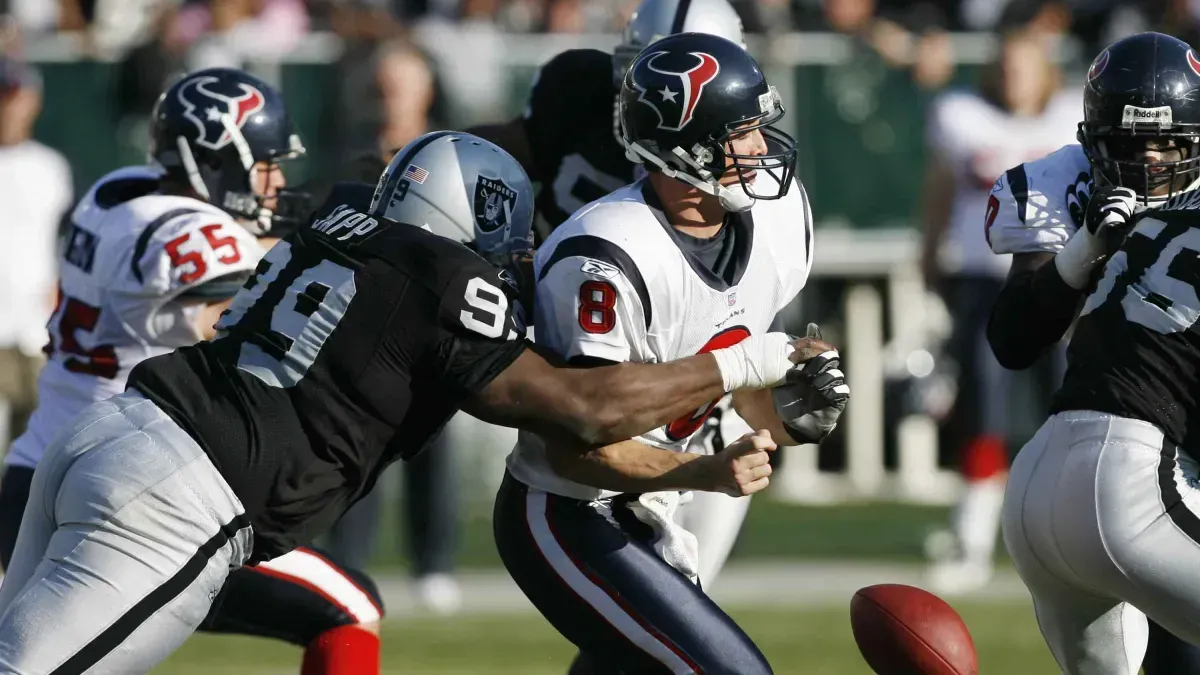
The most memorable aspect of the first-year Texans is the sacks. They allowed 76 of them, the most in the 21st century. Now, that's not an all-time NFL record, but both the 1986 Eagles (104 sacks allowed) and 1997 Cardinals (78) racked up sack numbers in part due to lesser-quality backups taking the field. David Carr, the first pick in Texans franchise, absorbed every single one of those 76 sacks. The only passer who has come close to breaking that record since was … David Carr, who took 68 more sacks in 2005. Carr ranks 79th in sacks taken since the stat was first recorded in 1970, which is bad enough, but he did it while only starting 79 games and playing in 94. Every single passer above him on the list is in triple digits in games played and usually significantly so. Carr is one of ten passers since the merger to be sacked on at least 10% of his dropbacks over at least 1,000 attempts, and joins Zach Wilson as the only two to do it in the 21st century. Yes, his offensive line was a sieve and Carr was essentially shellshocked after his first year, but other passers have been behind terrible lines without getting clobbered as much as Carr was. Carr held on to the ball and got to see plenty of the Reliant Stadium turf.
Maybe things would have been different if Tony Boselli, the first pick in the expansion draft, had ever suited up for Houston. But Boselli's pre-existing shoulder injuries kept him from ever playing a down. Or perhaps things would have been different if a strong running game had kept defenses honest. But Houston's -35.0% rush DVOA was worst in the league and second-worst in DVOA history. Maybe more talent elsewhere on offense would have helped, but Andre Johnson and Domanick Williams (then known as Domanick Davis) didn't arrive for another year. There just wasn't the talent to overcome the last-place team in both adjusted line yards and adjusted sack rate; the Texans are the only team to ever rank 32nd in both categories.
Now, the question is whether this Texans team was worse than the Oilers team from two entries ago. The only reason the Texans pass the Oilers is that it took them one more season to reach .500; Matt Schaub didn't arrive until 2007. Having four years instead of five is a double penalty for the Oilers, as it not only hurts them in sheer length of their Anti-Dynasty, but also "penalizes" their bottom-five DVOA as they don't have a fifth year to lean back on. I suspect that if the 2002 Texans faced off against the 1973 Oilers, the Oilers would have an advantage. Elvin Bethea might well get 16 sacks in one game in this matchup. But the Texans' defense wasn't terrible—they famously beat the Steelers with only 47 yards of offense thanks to three defensive scores. Dan Pastorini would have had real trouble solving Aaron Glenn. If these were the last Houston teams we'd see on this list, we could really hash this debate out some. Fortunately, they're not. Stay tuned.