Anti-Dynasty #31: 1957-70 Washington
The longest playoff drought in league history shows up on our list.

Peak Anti-Dynasty Points: 58
Record: 64-112-12 (.372)
Average DVOA: -12.2%
Bottom-Five DVOA: -27.9%
One last-place finish in the NFL; Two last-place finishes in the NFL Eastern
Head Coaches: Joe Kuharich, Mike Nixon, Bill McPeak, Otto Graham, Vince Lombardi, Bill Austin
Key Players: QB Sonny Jurgensen, QB Norm Snead, QB Eddie LeBaron, HB Dick James, FB Don Bosseler, WR Charley Taylor, FL Bobby Mitchell, TE Jerry Smith, OG Vince Promuto, C Len Hauss, C Jim Schrader, DE Bill Anderson, DT Joe Rtugens, DT Bob Toneff, LB Chris Hanburger, S Paul Krause
Z-Score: -0.60
Before I first sat down to do this project, I was positive that the 1960s Washington teams were going to make the top 10. Instead, they don’t even crack the top 30. We’re still in a section where teams have a few saving graces, to my surprise.
If you're a connoisseur of terrible football teams, you're familiar with the longest playoff droughts in league history . The record since the NFL instituted playoffs in 1933 is 25 straight years of packing your bags and going home, shared by the 1949-1973 Cardinals and 1946-1970 Washington. Neither of those teams make the Anti-Dynasty top 10, as both team's droughts are exacerbated by the smaller postseason. In 2026, 43.8% of the teams in the NFL will make the playoffs. If you had the same percentage back when these Washington teams were playing, they would have made the postseason seven times in that quarter-century. Taken in today's light, the early 1950s Washington teams are more Vikings than Browns, and not worthy of a list like this.
But oh, those late 1950s and early 1960s teams very much do belong here. Estimated DVOA has the 1959-1961 stretch as three of Washington's four worst-ever seasons, and 1958 and 1962 make the bottom 15, all of them at -20.4% or worse. And unlike some of the other teams we have covered before and will cover from now, these weren't a fun bunch of loveable losers either.
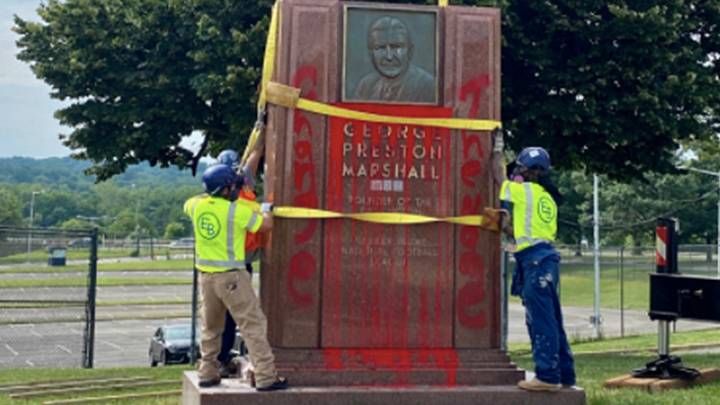
In those years, Washington was still being run by owner George Preston Marshall, an angry, bigoted old racist. As the owner of the NFL's southernmost team, Marshall once told a reporter "I have nothing against Negroes, but I want an all-white team." As Washington Post columnist Shirley Povich put it, the team's colors may as well have been "burgundy, gold, and Caucasian." Marshall had been the one to propose the agreement that kept African-American players out of the NFL until after World War II. It wasn't until Attorney General Robert F. Kennedy threatened to kick Washington out of D.C. Stadium in 1962 that Marshall finally caved and started signing black players. I could temper this picture by talking about the work he did to ensure the NFL got on television and so forth and so on, but no, this was a guy whose charitable foundation included a caveat that its money could not be used to support "racial integration in any form," so screw him. It takes a special brand of asshole to take "worst owner in franchise history" away from Dan Snyder, but Marshall was precisely that sort of asshole.
He was also a miserly and unprepared asshole, and that as much as anything tanked Washington on the field. Marshall would not sign players to big contracts, and certainly wouldn't outbid anyone else for talent. But it was in the draft when Marshall was the worst. The line at the time was that Washington's scouting budget was 50 cents, the cost of Street & Smith. Marshall was noted for making the rounds of the various other team's tables on draft day, shaking hands with the other owners—and peeking at their draft boards. A couple of teams started exposing lists of players they did not want, hoping that Marshall would take the bait. At times, it seemed to work—Marshall famously used first-round picks in consecutive years on an ineligible player (Cal Rossi), used seven of his first picks in a 13-year span on quarterbacks while ignoring a crumbling defense, traded away solid players for prospects who never panned out, and, of course, avoided drafting players such as Jim Brown or Jim Parker because of the color of their skin. It's no surprise Washington was so bad by the end of the decade; when the guy in charge of personnel is whiffing on high draft pick after high draft pick, is there any wonder the cupboard was bare?
In 1963, a stroke left Marshall legally incompetent to manage his affairs. I do not believe it is a coincidence that from 1957 to 1962, Washington averaged a -21.4% estimated DVOA, and were at -4.6% from 1963 to 1970. With Marshall out of the picture, head coach Bill McPeak also took over as general manager, and while McPeak's teams never had success on the field, he was central in drafting stars Charley Taylor, Jerry Smith, Paul Krause, Len Hauss, and Chris Hanburger, and trading for Sonny Jurgensen and Sam Huff, all of whom came to the team between 1964 and 1965. The team further approached … well, mediocrity, but still an improvement, when McPeak left and Otto Graham took over, and then had their first winning season in 15 years when Vince Lombardi was finally lured back to Washington 1969—they had tried to grab him in the middle of the decade while Green Bay's dynasty was in full swing, and he had said no.
Imaging what Lombardi could have done with the team in the 1970s is one of football's great What-Ifs, but Lombardi passed away due to cancer before the 1970 season began. Instead, the groundwork he laid in 1969 led the way for George Allen and his Over-the-Hill Gang. Marshall, who died in August 1969, never got to see what Lombardi or Allen could do with his team. Cue the world's smallest violin.