Anti-Dynasty #4: 1926-45 Chicago Cardinals
Somehow, still not the worst stretch in Cardinals history.

Peak Anti-Dynasty Points: 115
Record: 59-142-15 (.308)
Average DVOA: -10.0%
Bottom-Five DVOA: -33.6%
Six last-place finishes in the NFL; Ten last-place finishes in the NFL Western
Head Coaches: Norm Barry, Guy Chamberlain, Fred Gillies, Dewey Scanlon, Ernie Nevers, Roy Andrews, Jack Chevigny, Paul Schissler, Milan Creighton, Jimmy Conzelman, Phil Handler, Walt Kiesling
Key Players: BB Buddy Parker, WB Mickey MacDonnell, FB Mike Mikulak, FB Marshall Goldberg, E Chuck Kassel, E Bill Smith, E Herb Blumer, E Milan Creighton, T Chet Bulger, T Jake Williams, T Duke Slater, T Tony Blazine, T Lou Gordon, T Gil Duggan, G Howie Tipton, G Ross Carter, G Phil Handler, G Conway Baker, G Walt Kiesling, G Bree Cuppoletti
Z-Score: 9.33
Why have the Cardinals been the least successful franchise in history? Because they're cursed. CURSED!
The 1925 Chicago Cardinals are officially recognized by the NFL and the Pro Football Hall of Fame as the world champions, but they were not. Not at all. That title rightfully belongs to the Pottsville Maroons, and not just because it's much more fun to say "Pottsville Maroons" than it is to say "Chicago Cardinals."
With no championship game at this point in time, the NFL champion was just determined by which team had the best win-loss record, with ties not counting. And with no set schedules, teams could play as many teams as they wanted. All originally scheduled games were to completed by December 6, though the season would not officially come to an end until December 20—teams were allowed to schedule last-minute games to help them turn a profit for the year. On December 6, the Maroons beat the Cardinals 21-7, taking their record to 10-2, a half-game ahead of Chicago's 9-2-1 record. Your champions: the Maroons. But they still had one more game to play. Before the season started, the Frankford Yellow Jackets had scheduled an exhibition game against the Notre Dame All-Stars, an alumni team. But specifically, they had scheduled it for Notre Dame against "the best team in the east," only to be upset by Pottsville earlier in the year. Pottsville inherited the game and decided to keep it in Philadelphia as originally planned; it was a much larger stadium and they'd get more profit out of it. Frankford claimed this violated their territorial rights—you can't play a game in their backyard. Pottsville claimed the league gave them permission in a phone call that was conveniently never written down. The league suspended Pottsville, and prevented them from playing their last scheduled game against the Providence Steam Roller, so their final record stayed at 10-2. (They beat Notre Dame, for the record).
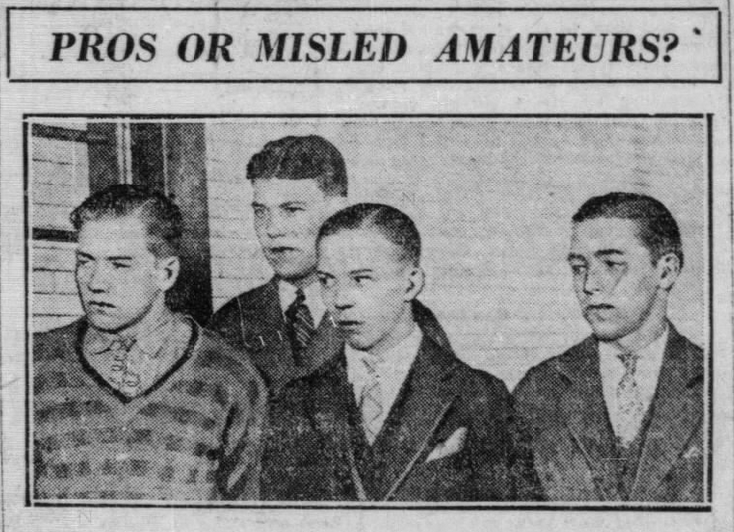
Meanwhile, the Cardinals were low on cash and needed to schedule some more games. Plus, they saw an opportunity—they were only a half-game behind the Maroons in the standings; they could catch them! Plan A was to schedule the Chicago Bears and Red Grange, but they weren't interested. So instead, the Cardinals contacted two teams that had already disbanded for the year—the Hammond Pros and the Milwaukee Badgers—and convinced them to re-form for games that would count. The Pros game went off without a hitch; a 13-0 win for Chicago. The Badgers, however, had a problem. Their owner lived in Chicago and couldn't really drag everyone from Milwaukee down for one game. So instead, the Cardinals' backup quarterback recruited four players from Englewood High School to adopt fake names and join the Badgers; all four played significant time. The result: a 58-0 win by Chicago. It should be noted that, even in the Wild West that was the 1920s, that was not a thing you could do. Signing a bunch of high school players and passing them off as a rival team was against the rules even then. The league promised that that game would be stricken from the records … but it never was. Both the Cardinals and Maroons had broken league laws, but only the Maroons were punished for it. Chicago's 11-2-1 record thus topped Pottsville's 10-2 record, and the Cardinals were recognized as champions.
Team owner Chris O'Brien refused to recognize the championship, saying he did not want to win the title that way. The Cardinals didn't start claiming it until 1933, when Charles Bidwill bought the team; the franchise continues to claim it to this day. And, because they claim a stolen title, the story goes, the franchise is now cursed—they have the longest active title drought in American professional sports.
That's crazy talk, of course. If that were to be true, we'd see a clear differentiation in quality between the 1926-1932 Cardinals, when they didn't claim the title, and the team from 1933 on. The 1926-1932 Cardinals had an average SRS-to-DVOA conversion of -3.7%. They were boosted by members of the All-1920s team: Ernie Nevers, Guy Chamberlain, and Walt Kiesling are all deservedly in the Hall of Fame, joined many years later by 100th anniversary inductee Duke Slater. With a record of 27-40-7, they certainly weren't a successful team, but they were a pretty clear stepping stone between the dominant teams that still exist today (the Packers, Bears, and Giants) and the fly-by-night teams that all folded in the first half of the century—a middling, inconsistent team that just produced a few more lowlights than highlights.
From 1933 to 1945, the Cardinals had an average SRS-to-DVOA conversion of -13.4%, including averaging below -30.0% over the last half-decade of that span. The war-era teams were particularly putrid, having been hit very hard by the draft. The 1942-1945 teams lost 29 games in a row, still the record for longest losing streak in NFL history, including back-to-back 0-10 seasons in 1943 and 1944; they are the only team in league history to have back-to-back winless seasons playing a full schedule. That 29-game losing streak came in the middle of a 1-36 run and opened the door for the fledgling AAFC to put a team in Chicago—they couldn't be more popular than the Bears, but they could certainly have been more popular than the Cardinals.
The 1944 team was another one of those merged war teams; with the Rams re-entering the league in 1944, the league had 11 teams and couldn't figure out a way to make the schedule work. The Steelers, who had merged with the Eagles the year before, were fine with merging again, but no one else was particularly interested. The league finally decided the 0-10 Cardinals were insignificant enough that it wouldn't be a competitive advantage for the Steelers to get their players. Art Rooney later called Card-Pitt the worst team in NFL history—trying to run the T-formation without a quarterback; getting dinged by their coaches for "indifferent play"; getting involved in a brawl on the field bad enough that Rooney, a former boxer, actually stormed the turf to take part in the fracas; inspiring star players such as John Grigas to retire rather than finish the season with such a putrid squad. Maybe Rooney has a point; our SRS-to-DVOA conversion clocks them in at a franchise-worst -48.3%.
So, uh, yeah. Maybe the Bidwills should consider giving up that title, just for a little cosmic cleaning. The Cardinals rebounded after the war, winning a title in 1947. But then the 1950s happened, which we covered down at No. 27. And then the team moved to St. Louis, and—and I can't believe I'm saying this at No. 4—you'll have to hold that thought for a day.
So why aren't the Cardinals No. 1? The late 1920s teams, while unsuccessful, were talented enough to keep Chicago's DVOA from plummeting too far down. Nevers, especially, was fantastic, one of the best football players from the first half of the 20th century. He holds the oldest individual record to never be broken or tied, scoring 40 points against the Bears in 1929, one of multiple occasions he accounted for all of Chicago's points. We joked about the curse coming in with the Bidwills, but Nevers retired in 1932 after breaking his wrist, saying he wanted to get out of the game while he was still in one piece. Nevers' teams were good enough to keep Chicago out of the very bottom of the cellar.