Anti-Dynasty #55: 1984-90 Detroit Lions
Both the auto industry and the football team collapse in Detroit.

Peak Anti-Dynasty Points: 36
Record: 37-73-1 (.338)
Average DVOA: -12.0%
Bottom-Five DVOA: -15.2%
Three last-place finishes in the NFC Central
Head Coaches: Monte Clark, Darryl Rogers, Wayne Fontes
Key Players: RB Barry Sanders, FB James Jones, OT Lomas Brown, DE Mike Cofer, NT Jerry Ball, LB Chris Spielman, LB Jimmy Williams, CB Bruce McNorton, K Eddie Murray
Z-Score: -6.81
The Detroit Lions started the 1980s with a game-altering running back wearing No. 20. The Detroit Lions ended the 1980s with a game-altering running back wearing No. 20. It's the period in between that didn't go so well.
The first runner was Billy Sims, the Heisman Trophy-winner from Oklahoma. The top pick in the 1980 draft, Sims hit the ground running—he's one of only 14 players to have at least 30 touchdowns in his first two seasons. He ran for over 1,000 yards in three of his first four seasons and would have done it in all four had 1982 not been curtailed by the strike. The Lions regularly put up top-10 rushing seasons in DVOA with Sims in the backfield, which was enough to propel Detroit to their first back-to-back postseasons since the 1950s.
And then, in 1984, Sims catastrophically blew his knee out midway through the season. And, as it turns out, an offense led by the likes of Gary Danielson and Eric Hipple is not going to strike fear in the hearts of, say, the Super Bowl Shufflin' Bears. While the extent of the dropoff is bigger in conventional stats than in DVOA, the Lions finished the year 1-6-1 and well out of contention.
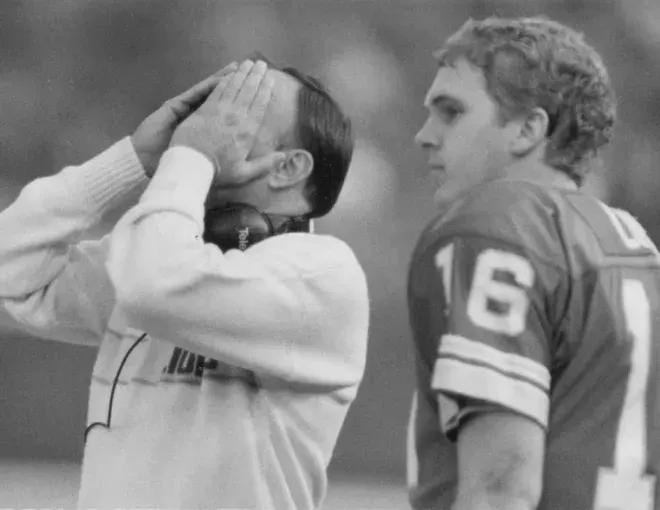
With their biggest offensive star gone, the Lions decided to bring in a new coach, an offensive guru to scheme up something new offensively. That was Darryl Rogers, an accomplished college coach who had a reputation as an ahead-of-his-time passing expert from Michigan State. With passing taking the league by storm in the 1980s, Rogers was going to be a perfect fit. He was going to bring a modern, exciting offense to Detroit. All you had to do was listen to him praise the Lions' roster in his opening press conference where he said, uh, "I cannot tell you one thing about the Lions. We have not talked about anything except the contract."
Under Rogers, the Lions produced their worst seasons in the back half of the 20th century. It nadired in 1988, with the Lions ranking dead last with a -25.2% offensive DVOA. They gained just 3,405 offensive yards, the second-lowest total in the 16-game era (RIP), and only hit 20 points three times. "What does a coach have to do to get fired around here?" Rogers quipped to the media, and it turns out, uh, it was that. That was enough. He was gone midway through the 1988 season.
In 1989, Lions added Barry Sanders, the Heisman Trophy-winner from Oklahoma State. The third overall pick in the 1989 draft, Sanders hit the ground running—he's one of only 14 players to have at least 30 touchdowns in his first two seasons. History doesn't repeat itself, but it often rhymes.
New head coach Wayne Fontes—who had been quietly keeping the defense working while Rogers' offense was floundering—was the one pounding the table to draft Sanders, and that wasn't his only savvy draft move. He gradually built up quite a collection of talent through the draft, with Bennie Blades, Chris Spielman, and Jerry Ball all drafted between 1987 and 1989. That culminated in the 1991 team that went 12-4 and ended a game short of the Super Bowl. The 1990s Lions never could put together much success in the postseason, but at least they were significantly less depressing to watch than their 1980s counterparts.