Anti-Dynasty #57: 1920-1922 Columbus Panhandles
What works on the railroad may not work on the gridiron.

Peak Anti-Dynasty Points: 30
Record: 3-22-2 (.148)
Average DVOA: -22.2%
Bottom-Five DVOA: -13.3%
Head Coaches: Ted Nesser, Herb Dell
Key Players: B Hal Gaulke, FB Frank Nesser, E Homer Ruh, T Joe Mulbarger, G Oscar Wolford
Z-Score: -7.17
The Panhandles squeak into eligibility due to playing 10 games in 1920, and thus getting their stats fully counted and prorated out to 16 games. At 2-6-2, with all four non-losses coming to non-league sides, this was the best season the Panhandles managed in their short history. The Panhandles went 1-8 and 0-8 in their next two seasons, with the lowest estimated DVOAs of any team that played more than five games at -31.6% and -31.1%. Trying to judge what counts as an "average" football team in the 1920s is iffy, at best, but the Panhandles were truly terrible and deserve to be mentioned here, albeit very low on the list.
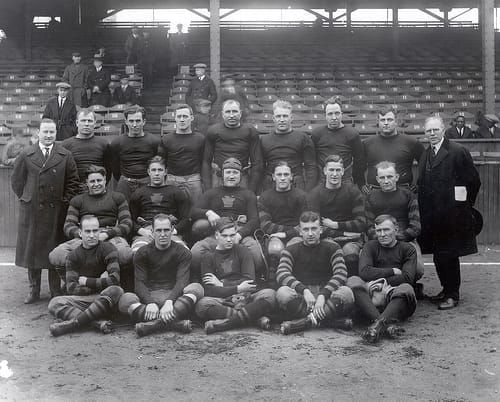
The Panhandles do have a Hall of Famer to boast, but not for anything on the field. Joe Carr ran the team from 1907 to 1922 when it was a successful travelling sandlot team. The "Panhandles" in the name refers to the Panhandle shops of the Pennsylvania Railroads, and Carr exploited the fact that the team was made up of "big hardy railroad men," using lunch breaks to practice and getting the team to ride the train free of charge to take on opponents as a travelling team.
The team was built around the Nesser Brothers, with six of them forming the backbone of the Panhandles from 1907 until the mid-1920s. The Nesser boys were huge, averaging more than 210 pounds apiece in an era where your linemen generally clocked in at about 180. The Panhandles quickly gained a reputation for being a big, nasty, dirty team, bullying their opponents. That, coupled with Ted Nesser's creativity as a playcaller for the era (he's credited with inventing the triple-pass and the criss-cross, staples of college teams in the 1920s) led to a team that dominated opponents in Columbus and drew large crowds wherever they went.
Well, if your team is based around a bunch of young players in 1907, you can imagine why they would have less success in the 1920s. By the time the AFPA formed, the Nessers were all in their mid- to late 30s, and that's not going to be ideal when you're trying to compete. Also, they weren't competitive in signing players, as the cost of running an actual team and not a railroad-adjacent sideshow became too much for Carr. He discontinued the team after 1922, focusing instead on his role as the NFL's first (active) president. The Panhandles became the Tigers and saw some early success. Carr was instrumental in transitioning the league from a ragtag group of local teams into a professional, national institution, and the Panhandles were more-or-less forgotten.