Anti-Dynasty #58: 1959-1965 Los Angeles Rams
The Fearsome Foursome can't end a frightful flop.

Peak Anti-Dynasty Points: 49
Record: 25-65-4 (.287)
Average DVOA: -8.4%
Bottom-Five DVOA: -11.5%
Two last-place finishes in the NFL; Three last-place finishes in the NFL West
Head Coaches: Sid Gillman, Bob Waterfield, Harland Svare
Key Players: HB Jon Arnett, HB Dick Bass, FL Red Phillips, DE Deacon Jones, DT Merlin Olsen, LB Les Richter, DB Eddie Meador
Z-Score: -9.48
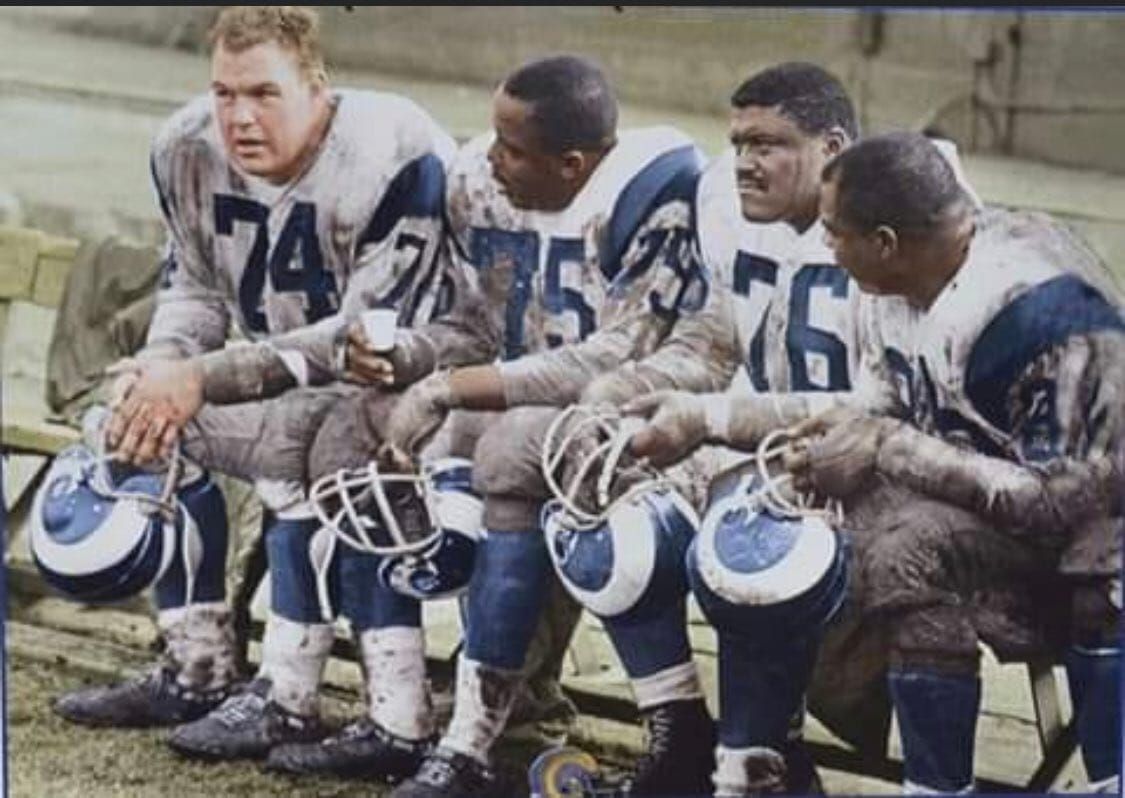
The story of the 1960s Rams starts with the Fearsome Foursome. Hall of Famers Deacon Jones and Merlin Olsen and stars Lamar Lundy and Rosey Grier comprised arguably the greatest defensive line in NFL history; a hard-hitting, aggressive-tackling squad that blew up offensive game plans before they began. They, and their eventual replacements, were the driving force behind the Rams' three straight double-digit-win seasons in the late 1960s. And yet, Lundy came to Los Angeles in 1957, and the entire foursome was in place by 1963. You'd think that assembling the line that early would lead to instant success, but the early 1960s Rams couldn't buy a win.
Blame it on the quarterback situation. Sid Gillman and his vertical passing game were out, and Norm Van Brocklin had been traded to Philadelphia in 1958, in part over issues of offensive control. That left the Rams in need of a new passer and passing philosophy. You can't say owner Dan Reeves (no, not that one) didn't do his damnedest to try to fix the problem. Strap yourselves in, because the Reeves and the Rams are going quarterback-huntin'.
Post-Van Brocklin, the Rams started with Billy Wade, a 1958 Pro Bowler and future NFL champion with the Bears. By 1960, he was platooning with Frank Ryan, a passer with lesser stats but a better win-loss record. In 1961, Reeves traded Wade to Chicago in exchange for their platoon quarterback, Zeke Bratkowski. Neither Ryan nor Bratkowski lit the field on fire, so the Rams traded Ryan away and used the second pick in the 1962 draft to take future MVP Roman Gabriel. Gabriel spent much of the season on the bench behind Bratkowski, with the rumors being that coach Bob Waterfield was not happy with the handsome young quarterback being overly friendly with his wife. Whether it was for refusing to play Gabriel or starting the year 1-7 (or both!), Waterfield was fired, and yet replacement coach Harland Savre turned to career nobody Ron Miller when he needed a new passer.
In 1963, the Rams used their first-round pick on quarterback Terry Baker. In 1964, the Rams used their first-round pick on quarterback Bill Munson. With three first-round passers on the roster … the Rams still turned to Bratkowski, with him and Gabriel even alternating plays from time to time. Platoon quarterbacks were more common in the 1960s, but by any modern standards, this is lunacy. Bratkowski had 4.49 adjusted yards per attempt in his time with the Rams; even the young, not-yet-great Gabriel was at 6.82. Imagine if a team kept starting J.J. McCarthy over Josh Allen and you'll have a rough era-adjusted idea of what the Rams were doing. The Rams had estimated offensive DVOAs of -11.6% and -10.0% in 1963 and 1964, with the answer sitting right there. Between 1962 and 1965, the Rams were 11-11-1 with Gabriel under center and 4-27-2 with anyone else. This is not hindsight saying the Rams were crazy; there was plenty of evidence with the tools at the time that they were stubbornly making the wrong decision.
In 1966, George Allen came in and brought actual competent coaching, a welcome relief after Waterfield's disorganization and Svare's macho act. Allen convinced Gabriel to not jump to the Raiders and the AFL, promising him the starting job, and the Rams took off from there. We really are in the middle of teams that just needed to get out of their own dang way.
The 1963 Rams Highlight Reel, such as it is