Anti-Dynasty #9: 1933-41 Pittsburgh Pirates/Steelers
Art Rooney's amateur men may have been the worst pre-war teams ever.

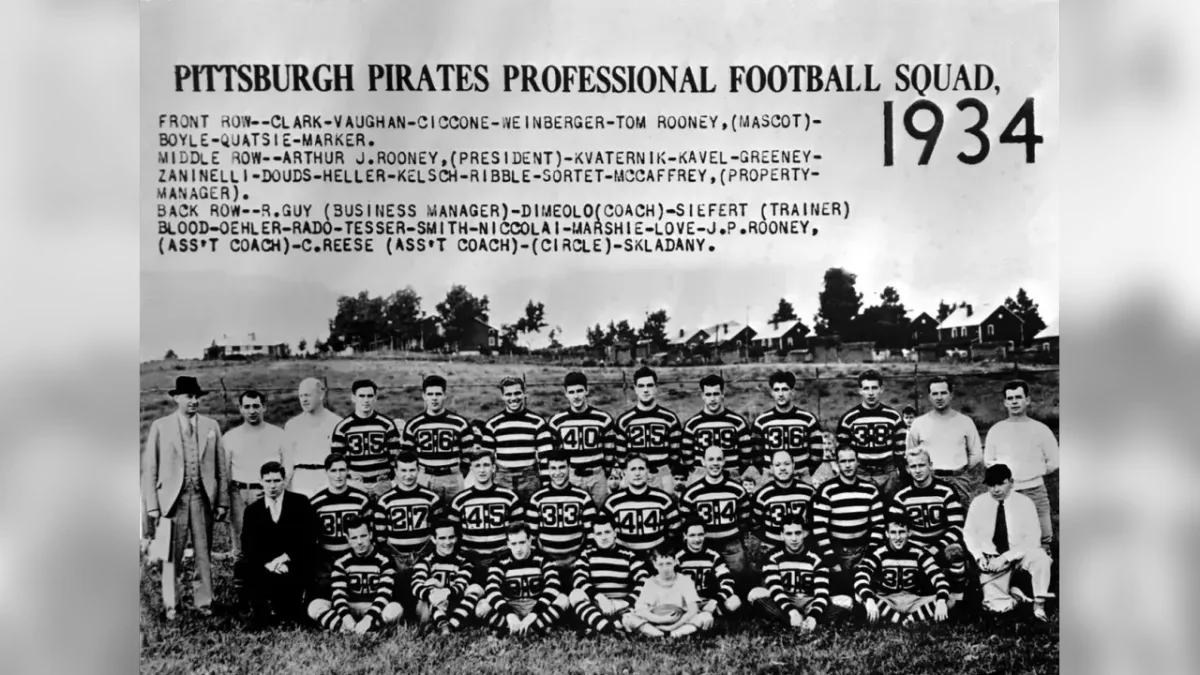
Peak Anti-Dynasty Points: 65
Record: 25-71-6 (.275)
Average DVOA: -26.9%
Bottom-Five DVOA: -33.6%
Two last-place finishes in the NFL, Eight last-place finishes in the NFL Eastern
Head Coaches: Forrest Douds, Luby DiMeolo, Joe Bach, Johnny Blood, Walt Kiesling, Aldo Donelli, Bert Bell
Key Players: TB Johnny Gildea, BB Silvio Zaninelli, E Bill Sortet, E George Platukis, T Armand Niccolai, T Sandy Sandberg, G Byron Gentry, G John Perko, G George Kakasic
Z-Score: 7.16
Before there was the Steel Curtain, there was the Same Old Steelers. One of those off-the-cuff quotes that gains a life of its own, that phrase became Pittsburgh fans' motto throughout the first four decades of the franchise. They never had back-to-back winning seasons until the late 1950s, only made one playoff appearance in their first 39 years of existence, and were never much in contention for anything—we already talked about their 1960s run back at No 33. And here they are again—this time, with the shortest run of anyone in the top 10, with the fewest Anti-Dynasty points. To get this high with this little resume requires colossal on-the-field terribleness, and yes, their SRS-to-DVOA conversion of -26.9% is the lowest mark in the top 10. Call them the Pirates, call them the Steelers, call them the Rooneymen, call them the Iron Men—a rose, by any other name, would stink just as badly.
We have already talked about how this team ended in the Eagles article earlier today, with the full exchange of franchises in the 1941 offseason. But they started rather oddly as well. You'll note both the Steelers and Eagles sprang to life in 1933, and that's not a coincidence—Pennsylvania's blue laws prevented organized sports competition on Sundays until April of that year. Previous professional football teams had gotten around that by playing home games on Saturdays and road games out of state the next day. Art Rooney got around that by running a semi-pro team throughout the 1920s, known alternatively as Hope-Harvey, the Majestic Radios, and the J.P. Rooneys. Rooney—owner, coach, and quarterback—had success and won some local sandlot titles. Going fully professional when the opportunity arose was a no-brainer. The team renamed themselves the Pirates, as was the style at the time, though most people still referred to them as Rooney's team or the Rooney Men to help distinguish them from the baseball team, because it turns out naming yourself the same thing as a different, better known team is a dumb idea.
It also turns out that by 1933, you couldn't just take a semi-pro team and hope to compete in the NFL, at least not with the Bears, Giants, and Packers. The team wouldn't beat New York until 1936, Green Bay until 1947, and Chicago until 1958. Excluding the Cardinals (and we'll get to them shortly), the Pirates went 0-12 against teams established in the 1920s before finally getting a win; they just could not build a team to compete.
The draft wasn't put into place until 1936, so for the first few years, the Pirates had to try to compete against those three clubs for college players. They didn't have the reputation or cash to do it, but their actual efforts were rather lackluster as well. They didn't try to recruit players until after the college season was over, by which time the big clubs had already gotten commitments from pretty much every prospect worth mentioning; by the time the Pirates came a-calling, the cupboards were bare. Also, they didn't have the money to send someone to watch anything but local games, so they relied on preseason guides (Art Rooney would have loved FTN Football Almanac 1934) and on just calling college coaches to ask if anyone was graduating. Even when the draft began, however, the Steelers didn't take advantage—their first ever pick, William Shakespeare (… no, not that one, though he did have the all-time nickname "The Merchant of Menace") never played for the team; they traded away the pick that became Sid Luckman; and while they did get Whizzer White, he only played one year for the team before going on to work on his law degree.
It was an amateur affair, with their entire seasons drawing fewer fans than one game for the University of Pittsburgh. Their coaches treated it as such, too—Aldo Donelli took up the Steelers as a side-job while coaching Duquesne; Johnny Blood once took a trip to the Rose Bowl and completely forgot that his team had a game that day back in Pennsylvania. Blood did manage to drive the team to a -9.0% estimated DVOA in 1937, but the Steelers were last or second to last in SRS in six of these nine seasons. No success on the field led to no fans. If it wasn't for Rooney's fantastic success betting on horse racing and promoting boxing matches, the Pirates would have gone belly-up. It certainly wasn't a money-making enterprise—hence why Rooney was OK selling the team and throttling down to 50% ownership of the Eagles during the big switcheroo of 1941. It was an expensive hobby that really didn't pay dividends until Rooney was well into his seventies.
So why aren't the Steelers No. 1? Because endpoints are hard. Technically, this run ends with the 1942 Steelers going 7-4 and the 1943 Steagles going 5-4-1—back-to-back winning seasons, and so we go kaput. But the Steagles are a combination of two teams, and while the Eagles went on to winning seasons after the merger, the Steelers took a bit longer. In 1944, they merged with the Chicago Cardinals (Card-Pitt) and went 0-10; it's safe to say the lion's share of the Steagles success came from Philadelphia. If we throw out 1943 as being fraudulent, the Steelers run lasts until 1945; enough to bump them up one spot but not more. The Steelers of the late 1940s and early 1950s weren't world-beaters, but they could generally be counted upon to be competent, especially when they became the last team to give up the single wing and join the T-formation revolution in 1952. They graduated from being terrible to being bland, and that's not great for positioning on a list like this.