Anti-Dynasty #11: 1948-58 Green Bay Packers
Nothing sets a fire under a team like a little arson.

Peak Anti-Dynasty Points: 74
Record: 37-93-2 (.288)
Average DVOA: -18.4%
Bottom-Five DVOA: -31.8%
Two last-place finishes in the NFL, Five last-place finishes in the NFL Western
Head Coaches: Curly Lambeau, Gene Ronzani, Ray McLean, Hugh Devore, Lisle Blackbourn
Key Players: QB Tobin Rote, HB Billy Grimes, HB Tony Canadeo, HB Breezy Reid, E Billy Howton, T Dick Wildung, C Jim Ringo, DE John Martinkovic, DT Dave Hanner, LB Roger Zatkoff, LB Bill Forester, S Bobby Dillon, S Val Joe Walker
Z-Score: 5.92
We were very, very close to seeing the Milwaukee Packers become a full-time concern. All it took to keep Green Bay in the NFL business was a little case of arson.
Let's back up just a moment. The 1935-1944 Packers made it all the way to tenth place on my dynasty countdown, with Don Hutson and the Notre Dame Box propelling the Pack to three world championships. But Hutson retired in 1945, alongside Cecil Isbell, Clarke Hinkle, and most of the other war-era stars; it was a significant talent drain. And the NFL was beginning to change. The Bears' T-formation was sweeping the league and would eventually become the offensive formation. But Curly Lambeau stuck with the box, their variation on the single wing, into the late 1940s. Even when he made the strategic shift in 1947, he insisted on having the ball frequently snapped to his tailback, behind the quarterback, just like in the single wing. This did not catch on, you may be shocked to learn. The game had passed Lambeau by, and the Packers were suffering for it.
The Packers were also suffering financially, being the one remaining team in a tiny midwestern market as the league completed its transition into a national concern. Lambeau was spending money like crazy, spending his offseason on team-funded "recruiting trips" which just so happened to be at the beaches of Palm Springs and Malibu. He also purchased Rockwood Lodge, an estate he was going to transform into the NFL's first stand-alone training facility. That's obviously not a bad idea, if perhaps a bit ahead of its time. More questionable was laying the practice fields over beds of limestone, which shredded the players' feet and knees on a regular basis. Three-hour scrimmages on top of barely-sodded jagged rocks is not, it turns out, ideal for players' long-term health, nor their morale. It's pretty good for the local bars that players frequented to help dull the pain, but that's about it.
Players hated the Lodge. And the team executives hated the Lodge, and Lambeau. They hated his spending habits, they hated that he divorced his high school sweetheart and married a wealthy California socialite, they hated his new slicked-back hair and tailored suits, they hated his womanizing around town, and they hated his team's poor performance. Packers co-founder George Calhoun went so far to say that he just wanted to "live long enough to piss on Lambeau's grave."
All that spending, and the tiny confines of City Stadium, meant the Packers were in real trouble towards the end of the decade. Even after cutting payroll (and getting worse on the field because of it), they were still in real danger of not being financially viable anymore. It got to the point where Lambeau held back players' checks for one week, saying that their effort was too lacking to get paid—and then never actually giving them the missing check. But Lambeau had a solution: four investors who would pay $50,000 each for the rights to the team, turning it from a publicly owned franchise into a privately owned one (and, it was widely rumored, with plans on moving everything out to Malibu as part of the league's expansion). The Packers president offered a counter-proposal: a new contract that stripped Lambeau of all authority except as head coach. Lambeau spat on it and left.
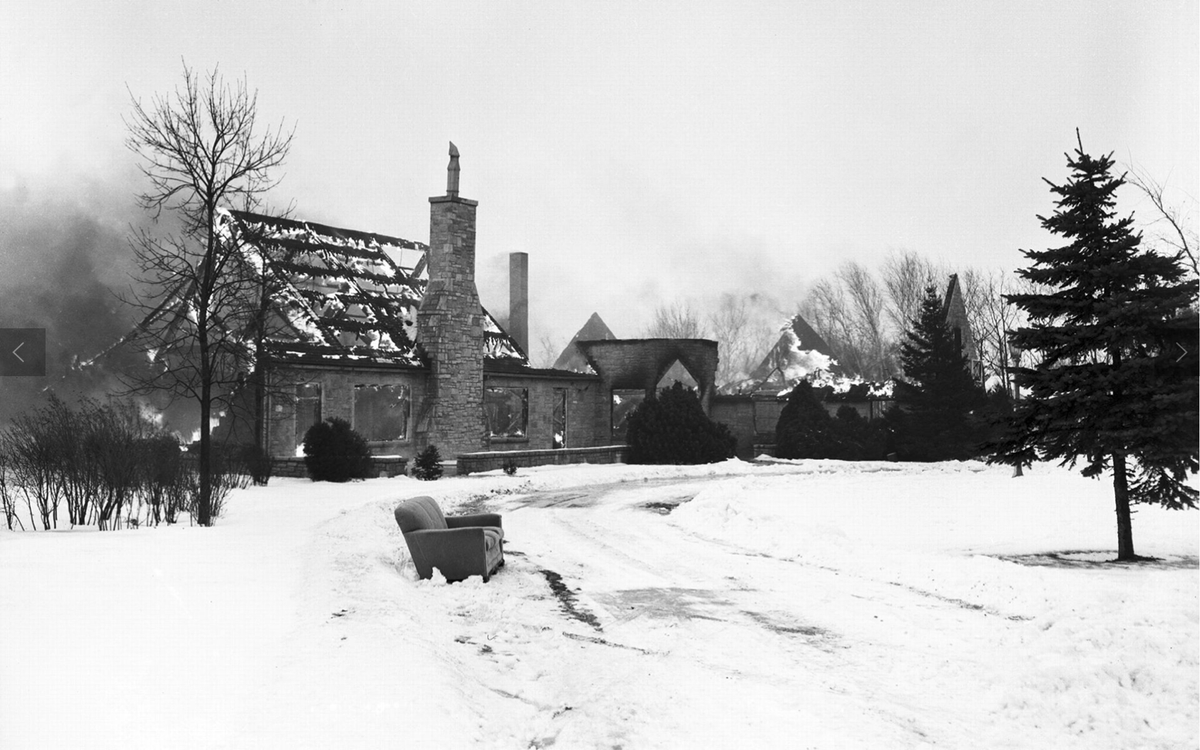
That didn't solve the money problems, but the fickle hand of fate did. On January 24, 1950, a mysterious fire ripped through Rockwood Lodge, destroying the site entirely. Thank goodness it was insured! And it just so happened that the $50,000 in insurance money nearly exactly matched the team's debts. What a wacky coincidence! (For legal reasons, I suppose I should state that the cause of the fire was never officially determined. Defensive back Ken Kranz claimed that the team torched it, and star halfback Tony Canadeo said that while he didn't set the fire, he was certainly fanning it. But maybe it was poor electrical wiring … in a conveniently empty lodge. Sure. Let's go with that).
That saved the Packers, although they didn't get on solid financial footing until building New City Stadium, which you know as Lambeau Field, in 1957. They were playing more and more games in Milwaukee just to earn more money from ticket sales in the interim. As for the product people were paying to see? Well, it was better than the end of the Lambeau era; Green Bay put up four seasons of single-digit estimated DVOA between 1952 and 1956 as they rebounded from the dregs of the 2-10 penniless 1949 team. That didn't always translate to wins, however. Green Bay did not have a winning season between 1948 and 1958. By the end of the run, they were being run by a local high school coach, Lisle Blackbourn. Liz was a pretty good eye for talent, drafting Forrest Gregg, Bart Starr, Paul Hornung, Jim Taylor, Jerry Kramer, and Ray Nitschke. But he couldn't get much out of them on the field, and the team floundered to a -32.0% estimated DVOA in 1958, worst in franchise history. That led to team hiring some guy named Vince Lombardi and giving him complete control over the roster. I'm told that ended up working out OK.