Anti-Dynasty #41: 1969-75 Chicago Bears
The Monsters of the Midway fail to find an offense. Repeat ad nauseum.

Peak Anti-Dynasty Points: 47
Record: 28-69-1 (.291)
Average DVOA: -14.1%
Bottom-Five DVOA: -19.0%
One last-place finish in the NFL; Six last-place finishes in the NFL/NFC Central
Head Coaches: Jim Dooley, Abe Gibron, Jack Pardee
Key Players: QB Bobby Douglas, WR Dick Gordon, WR George Farmer, TE Rich Coady, T Randy Jackson, DT Wally Chambers, LB Dick Butkus, LB Doug Buffone, CB Joe Taylor, K Mac Percival
Z-Score: -3.25
Stop me if you've heard this one before: the Chicago Bears were solid enough on defense, but a lack of consistent offensive performance severely limited their ceiling. You can take that sentence and apply it to basically any Bears team post-World War II, or at least post-George Halas; it is the history of Chicago in a nutshell. The exact definitions of "solid on defense," "constant performance," and "ceiling" have varied over the years, but since Halas retired for good in 1967, the Bears have had a better DVOA (or estimated DVOA) on defense than offense 42 times in 58 seasons. Only six of the 14 teams that were better on offense actually had a positive DVOA—generally, their offenses only look better when the defense is actively crumbling. Their longest stretch of offense-lead teams was 2013-2016, with Jay Cutler and Matt Barkley as their quarterbacks. The fact that a franchise can have this sort of identity for more than half a century defies belief; how can a team fail to replace Sid Luckman for 60 years?
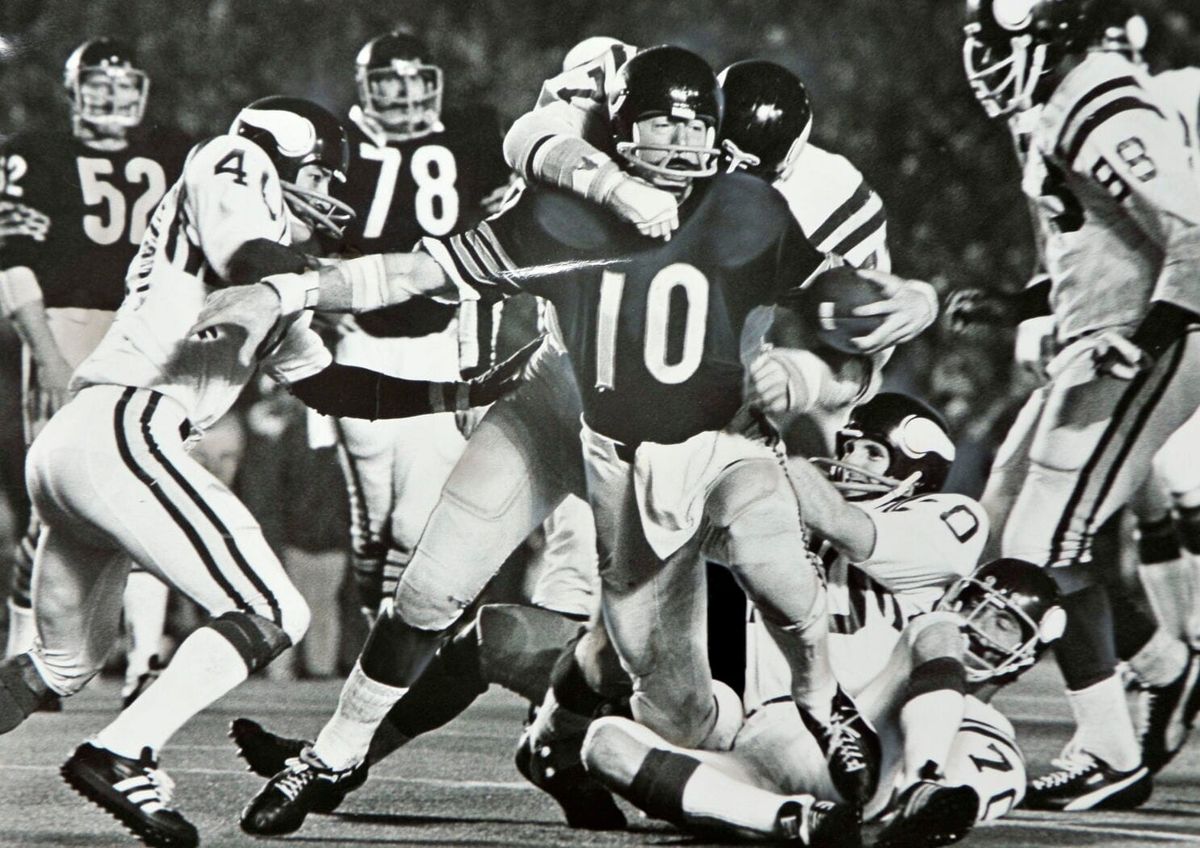
The Bears were better on defense than offense in each of these seven seasons, as one might expect. It also nicely fits in the pocket between Gale Sayers' 1968 knee injury and the selection of Walter Payton in 1975; in the run-first 1970s, it makes sense that a gap between Hall of Fame rushers would have a negative impact on your offensive performance. Instead, the Bears' leading rusher in this run was quarterback Bobby Douglass, who may well have been ahead of his time.
There had been scrambling quarterbacks before, and tailbacks who threw the ball, but not really rushing quarterbacks until Douglas came along. Douglas ran for 968 yards in 1972, which remained the record until Michael Vick broke it in 2006. He topped 400 yards twice more, joining Randall Cunningham and Steve Young as the only quarterbacks to top 400 rushing yards three times in the 20th century. Nowadays, of course, this isn't uncommon at all— Josh Allen has done it eight times, Lamar Jackson seven, and Jalen Hurts and Kyler Murray each have done it five times, and that’s without getting out of the past decade—but to do this in the 1970s was unheard of. Maybe if Douglas had come out today, he'd be the centerpiece of a modern RPO system—or maybe not, because he couldn't hit the broad side of a barn. He had a 42% completion rate in Chicago, and while you do have to take into account that this was the 1970s, teams were completing more than 50% of their passes back then. That year he ran for 968 yards? He only threw for 1,246, while tossing 12 interceptions in just 198 pass attempts. When you adjust for era, the only quarterback who had a worse season than that in the last three years was Anthony Richardson in 2024. When your best offensive player is “slightly better Anthony Richardson”, you are going to have problems.
It didn't have to be this way, either. The 1969 Bears went 1-13, the worst record in franchise history. That one win came against the Pittsburgh Steelers, who also went 1-13. Pittsburgh thus got the first overall pick in the 1970 draft, and they selected Louisiana Tech quarterback Terry Bradshaw. The Bears traded their second pick for Lee Roy Caffey, Elijah Pitts, and Bob Hyland, who played a combined 28 games for Chicago. Now, Bradshaw probably doesn't become Bradshaw away from the Steel Curtain and the excellent drafting of the 1970s Steelers, but he would still have been backed by Dick Butkus' defense, and would eventually have Walter Payton instead of Franco Harris at running back; maybe that pick alone could have avoided years of pain for Chicago. At the very least, we likely wouldn't be sitting here in 2026 wondering if the Bears were ever going to find a quarterback better than Sid Freaking Luckman.
The 1974 Bears retool, which didn't really take.