Anti-Dynasty #45: 1944-48 Boston Yanks
The Boston Yanks spent their entire existence wishing they were in New York.

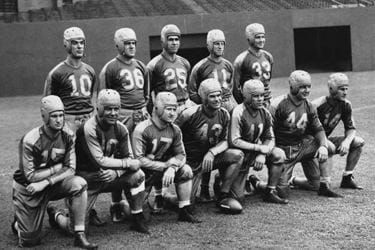
Peak Anti-Dynasty Points: 36
Record: 14-38-3 (.282)
Average DVOA: -27.0%
Bottom-Five DVOA: -10.0%
Two last-place finishes in the NFL East
Head Coaches: Herb Kopf, Clipper Smith
Key Players: B Bob Davis, E Nick Scollard, T Carroll Vogelaar, G Augie Lio, C Joe Domnanovich
Z-Score: -3.66
Alright, this is a bit of a weird one. This entry represents the entire history of the Boston Yanks, and it's one of the more complex and strange histories of any NFL franchise, especially one as late as the 1940s. 1920s teams formed and folded all the time, but by the 1940s, the league had settled down somewhat. The Yanks are one of only two NFL teams that formed in the 1940s; if you wanted to start a new team after World War II, you did so in the All-American Football Conference. And yet the history of three new franchises all meld into one in a gnarled knot of a continuity snarl that would make DC Comics blush.
First of all, the team name. "Boston Yanks" is not a thing. Ted Collins, the owner, wanted to own the New York Yanks, playing games in Yankee Stadium and drawing in crowds based on name recognition. This was a fairly standard practice at the time; in fact, there had already been a brief, unrelated New York Yankees NFL team in the 1920s. But the Giants didn't want anyone else sharing their market, and so Collins had to settle for playing games in Fenway Park instead. Naming your football team after the biggest rivals of the local baseball team is not exactly a recipe for long-term success.
In 1945, they were just the "Yanks." During World War II, teams frequently temporarily merged in order to save on money and manpower. In 1943 it was the Steelers and the Eagles. In 1944, it was the Steelers and the Cardinals. In 1945, it was the Yanks and the Brooklyn Tigers. Despite getting to merge with a team from the New York area, the Yanks still played most of their games in Boston. And despite having two teams' worth of players, the Yanks were still terrible, partially because Brooklyn had been 0-10 the year before and were not bringing much to the table.
Collins had agreed to merge in 1945 with the idea of weaseling his way into New York. Tigers owner Dan Topping had just bought partial interest in the baseball Yankees, and getting in on that deal seemed to be the path to the New York football team of his dreams. Instead, in 1946, Topping left the league and started a new team: the New York Yankees of the AAFC. He left all his players behind for Collins and the Yanks, which is the exact opposite of what Collins wanted—he now had New York's team in Boston, rather than his team in New York. This rubbed Collins the wrong way, and he complained to the league for years until the finally gave in, allowing him to move the team to New York in 1949. But instead of just moving the team, Collins asked the league to fold the Boston Yanks for tax purposes, and start a new franchise in New York that just happened to have all the same players and equipment and owner and everything else. And so that is what they did, and that ends the story of the Boston Yanks.
So, in 1949, you had the old Boston Yanks now calling themselves the New York Bulldogs—an unofficial continuation of the Brooklyn Tigers, which were themselves an unofficial continuation of the Dayton Triangles—playing across town from the New York Yankees of the AAFC, owned by the previous owner of the Brooklyn Dodgers who had become the Brooklyn Tigers but were in no affiliated with either of those previous teams. And then the AAFC folded, and the Bulldogs changed their name to the New York Yanks. And then in 1952, they were sold to a consortium from Texas who named them the Dallas Texans, but not those Dallas Texans, and then the team folded and sold all of its players and assets to a new Baltimore Colts (not to be confused with the Baltimore Colts that came from the AAFC to the NFL in 1950), and I need an aspirin.
Oh, all these teams were terrible, in case you were wondering, with estimated DVOAs falling between -19.2% and -42.1%, making this all a huge waste of time for everyone involved.