Anti-Dynasty #51: 1970-76 San Diego Chargers
The Chargers don't fear the reaper, but DO fear the reefer.

Peak Anti-Dynasty Points: 37
Record: 30-63-5 (.332)
Average DVOA: -13.5%
Bottom-Five DVOA: -17.7%
One last-place finish in the NFL; Four last-place finishes in the AFC West
Head Coaches: Charlie Waller, Sid Gillman, Harland Svare, Tommy Prothro
Key Players: QB John Hadl, RB Mike Garrett, WR Gary Garrison, T Russ Washington, T Terry Owens, G Walt Sweeney, G Terry Owens, CB Bob Howard, CB Joe Beauchamp
Z-Score: -5.26
The history of the San Diego Chargers is a rollercoaster. They were the best team in the first half of the AFL's life, making five of the first six AFL Championship Games. The Don Coryell era saw them reach four postseasons in a row in the late 1970s. They made the Super Bowl in the 1990s. And yet this is already their second appearance on the countdown, and they've got another coming very shortly. The Chargers: really good or really bad, but for relatively brief periods of time. It's an ethos, I suppose.
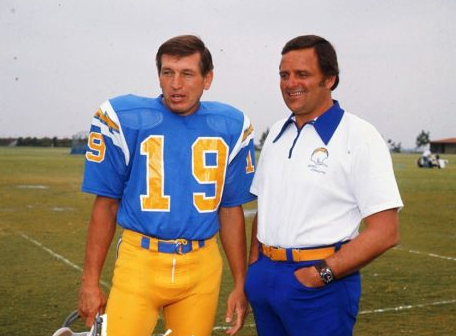
The Chargers had been great in the early 1960s, but by 1970, the stars of that era were either retired, traded, or on their last legs. The man responsible for fixing these problems was general manger Harland Svare. Svare was the first person not named Sid Gillman to have any significant control over the Chargers roster, and he was hired by owner Gene Klein, reportedly because he was easy to control. Svare quickly went to work dismantling the Chargers, starting by trading Lance Alworth in 1971. In the 1972 offseason, Svare made 21 separate trades (still an NFL record), bringing in over-the-hill veterans such as Deacon Jones and John Mackey and malcontents such as Duane Thomas. And then, in 1973, he traded away aging 33-year-old passer John Hadl (who had just made the Pro Bowl, by the by), and brought in … aging 40-year-old passer Johnny Unitas. The sight of Unitas, limping his way through one final season in the wrong uniform, is one of the sadder images in NFL history. Svare's reward was a five-year contract, announced at halftime of yet another Chargers' loss. This was met with a chorus of boos, angry chants from the fans for the next year and a half until he resigned, and a near-lynching by drunk, angry fans after a 41-0 drubbing. That'd probably get me to quit, too.
We could go on about the Chargers' on-field performance in this era—usually adequate on offense, as the aging Hadl eventually turned into a green Dan Fouts, and usually terrible on defense—but the 1973 season was nicknamed The Nightmare Season not for what was happening on the field, but what was happening on the sidelines. Klein and Svare were worried—obsessed, even—about the possibility that the Chargers were using marijuana in the locker room. It would destroy their ability to play football, they feared, so they brought in psychiatrist Arnold Mandell to "hang out" with the team and keep an eye on them for news of the dreaded reefer.
What Mandell did instead was pass out scripts for Dexedrine and Phenobarbital like they were candy, prescribing over 1,700 doses of the stuff in the first few weeks of the 1973 season. For context, 1973 was also the year that the NFL banned amphetamines from being handed out by teams, in part due to the settlement of a lawsuit against the Chargers earlier that year. Mandell's presence was a handy workaround, and it might have gone without notice … except Svare was so concerned about the potential pot use in his locker room that he went to NFL commissioner Pete Rozelle to ask for help. Rozelle, more concerned about the reputation of the league just after settling a major lawsuit, advised Klein and Svare to hire private investigators (including, allegedly, prostitutes wearing wiretaps), and the NFL would take appropriate action based on the findings. No (significant) evidence of marijuana was found, but those investigators sure found out about all the illegal amphetamines! Eight Chargers were eventually fined and suspended (and later traded). Svare and Klein faced massive fines, with Svare stepping down as coach. Mandell was sanctioned by the California Medical Board and barely kept his medical license. Plenty of other teams were using drugs in the 1970s, but only the Chargers narced on themselves. Obsession, paranoia, panic attacks—quick, where's the number for the 1970s commissioner's office?