Anti-Dynasty #60: 1983-91 San Diego Chargers
Air Coryell beings a long, agonizing tailspin.

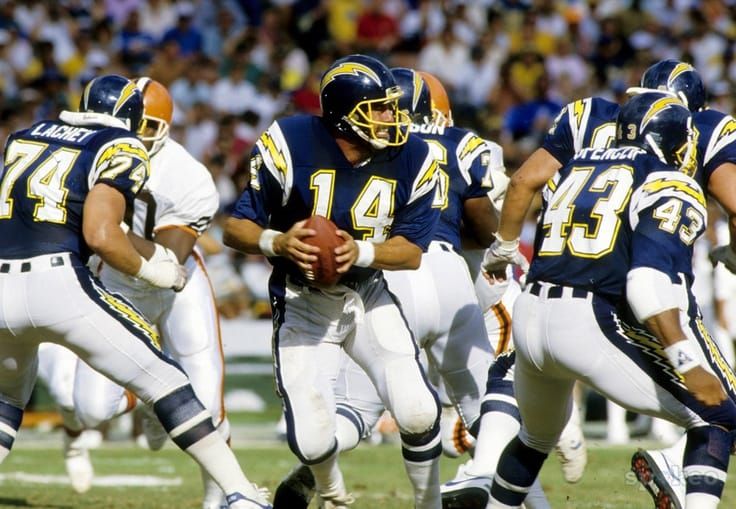
Peak Anti-Dynasty Points: 33
Record: 55-88 (.385)
Average DVOA: -5.2%.
Bottom-Five DVOA: -10.2%
Five last-place finishes in the AFC West
Head Coaches: Don Coryell, Al Saunders, Dan Henning
Key Players: QB Dan Fouts, RB Marion Butts, RB Gary Anderson, WR Wes Chandler, WR Anthony Miller, TE Kellen Winslow, DE Leslie O’Neal, DE Lee Williams, LB Billy Ray Smith, CB Gil Byrd
Z-Score: -10.69
Wait, Dan Fouts? Kellen Winslow? Don Coryell? These names are the backbone of the San Diego Super Chargers squads that made four playoff appearances in a row in the late 1970s and early 1980s, the teams that made back-to-back AFC Championship Games and are one of the greatest "What Ifs?" of that era of football. With names like that, it's not surprising that the Chargers are the lowest team on the list, but the 1980s in San Diego were a case study in what happens when Air Coryell is grounded. After coming so close to bringing a title to San Diego, the Chargers wouldn't win more than eight games in a season nor finish higher than third in the AFC West throughout this run.
Part of the reason was natural decline. The Air Coryell Chargers were always an offense-first team—they led the league in passing yards for six straight years from 1978 to 1983, still an NFL record—but were at least competent on defense throughout the 1970s. That defense started falling apart in the 1980s, however. The 1975 draft class brought in Fred Dean, Gary Johnson, and Louie Kelcher, who provided the backbone for Coryell's good defenses, but all were gone by 1984—Dean was traded to the 49ers in 1981, and Kelcher and Johnson joined him in 1984. Add in the retirement of Leroy Jones and the Bruise Brothers were no more. From 1983 to 1985, the Chargers finished 25th, 26th, and 28th in defensive DVOA; all three seasons are in the top 10 most points allowed in franchise history, even in a lesser offensive age. Fouts and the offense were still effective through the mid-1980s, but by the time defensive reinforcements arrived, the offensive stars were retired. It was a little like the Bengals of today; all the offensive fireworks in the world couldn't make up for the defensive void.
Why were all those defenders being shipped up the coast to San Francisco? Because the Chargers were being sold. Longtime owner Gene Klein had always been somewhat notorious for refusing to renegotiate contracts, and he was even less inclined to do so when actively trying to sell the franchise; adding payroll would make the team less enticing for Alex Spanos. That's not the end of the world when you're replacing players with equivalent, cheaper talent, but the 1980s Chargers simply weren't.
The Chargers managed to have three first-round picks in the loaded 1983 draft and came away with no superstars. While Billy Ray Smith, Gill Byrd, and Gary Anderson were alright, the Chargers passed up on Hall of Famers Bruce Matthews, Jimbo Covert, and Darrell Green to take them, as well as 1980s stars such as Joey Browner and Don Mosebar. They lost 1984's first-round pick, Mossy Cade, to the USFL. 1986's first-round pick, guard James FitzPatrick, was poor enough that management made a point of going to the L.A. Times to say that the team would be better once he was cut. Spanos, a self-made billionaire, thought he could run the team like one of his construction businesses, constantly second-guessing and overruling his staff. Most notably, he ordered disgruntled Jim Lachey to be traded to the Raiders – who quickly turned around and sent him to Washington, where he became one of the Hogs and helped Joe Gibbs win a title. Spanos promised a title within five years of taking over the team, but eventually he did figure out he was in over his head.
That realization is what ended up turning the Chargers around. In 1990, Spanos hired Bobby Beathard as general manager and gave him full reign. Beathard had already helped turn Miami and Washington into Super Bowl champs. He was responsible for drafting players such as Junior Seau and Rodney Harrison, and for trading for Stan Humphries to replace the revolving door at quarterback post-Fouts. In 1992, Bobby Ross took over as head coach and the Chargers won their first division title since 1981. Two years later, they were in the Super Bowl. Sometimes, you just have to get out of your own way.
The 1988 Chargers Yearbook