Anti-Dynasty #36 and 37: 1931-45 Brooklyn Dodgers/Tigers
The most confusing franchise in NFL history finds its way to the Anti-Dynasty list.

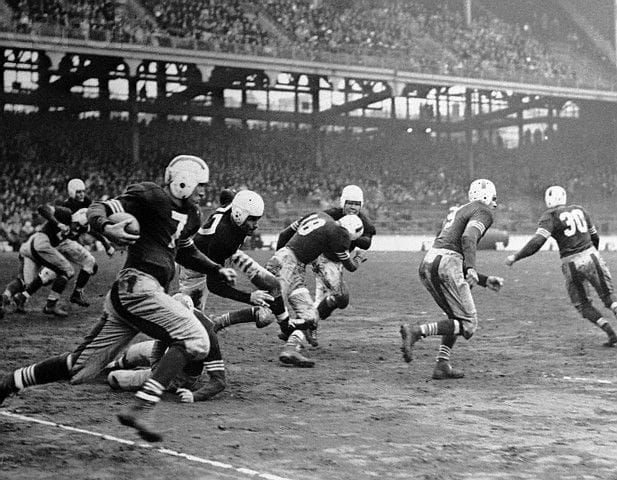
No. 37: 1931-1939 Brooklyn Dodgers
Peak Anti-Dynasty Points: 36
Record: 33-63-8 (.356)
Average DVOA: -17.5%
Bottom-Five DVOA: -23.6%
Head Coaches: Jack Depler, Benny Friedman, Cap McEwan, Paul Schissler, Potsy Clark
Key Players: TB Ace Parker, TB Stumpy Thomason, WB Ralph Kercheval, BB Bull Karcis, BB Father Lumpkin, E Paul Riblett, T Lou Lubratovich, T Bill Lee, G Stu Worden
Z-Score: -2.64
…You know what? Hold that thought.
No. 36: 1942-45 Brooklyn Dodgers/Tigers
Peak Anti-Dynasty Points: 35
Record: 2-24-2 (.107)
Average DVOA: -33.0%
Bottom-Five DVOA: -33.6%
Four last-place finishes in the NFL
Head Coaches: Jack Forsyth, Doc Alexander, Leo Lyons, Johnny Murphy, Tex Grigg
Key Players: WB Bob Argus, BB Shag Sheard, E Spin Roy, G Darby Lowery, C Hank Smith
Z-Score: -2.63
Ah, there we go. And, with these two entries, we can close the books on the Triangles/Dodgers/Tigers/Yanks/Texans mess of an early franchise. Not quite on the Colts, who distantly inherited all of this, but at least we're through with charting the course of this motley crew. Under one name or another, this set of teams had five winning seasons between 1920 and 1956. It turns out, that's quite bad!
You may have several questions. I'll do my best to answer them chronologically.
Wait, aren't the 1930s teams the same as the Triangles from entry 43?
Yes and no. Two businessmen from Brooklyn bought the franchise and moved it to Ebbets Stadium, and they imported a roster … from the Orange/Newark Tornadoes, a different terrible and short-lived franchise. In the midst of the Great Depression, moving an entire roster from Dayton to Brooklyn wasn't financially prudent, and besides, the Triangles were terrible. One bad roster is very much the same as another in the long run.
The terrible roster actually improved rather quickly, to be honest. At one point or another, the 1930s Dodgers employed a trio of Hall of Famers—Benny Friedman, Ace Parker, and Red Badgro. They also had multi-time All-American halfback Chris Cagle, All-Pro back Jack McBride, and fantastic kicker Ralph Kercheval. The problem is, they rarely had all of these players at the same time, with players coming in only for a year or two before leaving for greener pastures. The 1935 squad was practically an all-rookie select. Frantic ownership changes didn't help, either—owners of the New York Yankees, New York Americans, and Pittsburgh Pirates (baseball, hockey, and hockey, confusingly enough) all owned a piece of the franchise for a year or two. Even in the 1930s, that kind of chaos wasn't conducive to success, and so while the franchise would occasionally flirt with .500, they were generally third or fourth out of five teams in their division.
Well, then, what happened in 1940? Why are these two different teams?
In 1940, Jock Sutherland came in as head coach, and he brought with him his single-wing attack from Pittsburgh. That was an immediate success—Ace Parker won league MVP in 1940, Pug Manders won the rushing title in 1941, and the Dodgers went 15-7, finishing second in their division each year. Those were pretty good teams. We're not here to talk about pretty good teams.
But if the early-1940s Dodgers were good, what happened in 1942?
It's not so much what happened in 1942 as it is what happened on December 7, 1941. The Dodgers lost Sutherland, Parker, and a plethora of other players to service in World War II. With their core gone and fans losing interest, the team floundered and flailed. They went 0-10 in 1944, merged with the Boston Yanks for one season in 1945, and were done.
The Yanks?
Yes, the 1945 Yanks (or "Bos/Bkn Yanks/Tigers," as Pro Football Reference so pithily calls them) count for both the 1940s Tigers and the Yanks from entry 45. This isn't the last time we'll encounter the World War II merged teams, though oddly enough it is the only time one team counts for two entries.
So the Tigers just folded in 1945, and that's why their second entry ends there?
No, actually. They moved back to New York and became the New York Yankees in the AAFC—and had immediate success, reaching the AAFC Championship Game in both 1946 and 1947. And then they merged with the AAFC's Brooklyn Dodgers to become the Brooklyn-New York Yankees, as if this mess of a franchise needed yet more complexity in their history. When the AAFC folded, most of the players were given back to the New York Yanks, merging them back into the main branch of pre-Colts history.
I feel like I need one of those crazy-person conspiracy walls to keep this all straight.
Why are the 1940s Dodgers ahead of the 1930s Dodgers?
One of the fundamental questions of this project is whether it's worse, as a fan, to root for bad teams for a long time or terrible teams for a short time. The answer as always depends on just how we're defining "long" and "terrible" in any given case, and this one ends up in nearly a dead tie. Prorating things out to 16-game seasons, the 1930s Tigers basically won five or six games every year for a decade, while the 1940s Tigers won three or four for half as long. That two-game difference basically makes this a dead heat; one year more or less for either run and you'd flip the order.
In short, the 1930s Dodgers are the Atlanta Falcons; years of mediocre play intercut with occasional false hopes. The 1940s Dodgers are the current Tennessee Titans, a team that can never be credited with giving their fans false hopes, or any hope at all, really. Which is worse is a matter of opinion.